The Best 2-Day Dolomites Itinerary: Alpe di Siusi & Val di Funes in Autumn
If you’ve ever scrolled through travel photos and stopped dead at a tiny red church surrounded by golden meadows and jagged peaks, you’ve already seen the Dolomites. This Dolomites 2-day itinerary takes you through two of the most accessible yet breathtaking corners of South Tyrol — Alpe di Siusi and Val di Funes — without the summer crowds or the winter closures. Late September and October offer a rare sweet spot: open roads, amber light, and prices that haven’t yet hit ski-season levels.
How to Get to the Dolomites
The closest international airports are Verona (approx. 2h drive), Venice Marco Polo (2h15), Innsbruck (1h45), and Munich (2h30). From Lisbon, Porto, or other European capitals, return flights to Verona or Venice typically range from €80–€180 in shoulder season (April–May or September–October), depending on how far in advance you book.
A car is essential for this itinerary. Public transport into the valleys exists but is slow and infrequent, and the freedom of a rental changes everything. Centauro offers competitive rates with pickups at Verona and Venice airports — budget around €105 per car for the two-day rental, plus fuel and tolls averaging €200 for the full trip. That works out to roughly €150–€160 per couple for all road costs combined, which is very reasonable given the distances involved.
Flixbus connects major Italian cities to Bolzano (the regional capital), from around €15–€25, but from Bolzano you’ll still need a local bus or taxi to reach the valleys.
Day 1 — Val Gardena & Alpe di Siusi: The Roof of the Alps
Base yourself in Ortisei (Urtijëi in Ladin, St. Ulrich in German) — a compact, walkable village in the heart of Val Gardena that sits at about 1,200m and avoids the altitude-related road closures that affect higher spots in late October.
Morning: Seceda
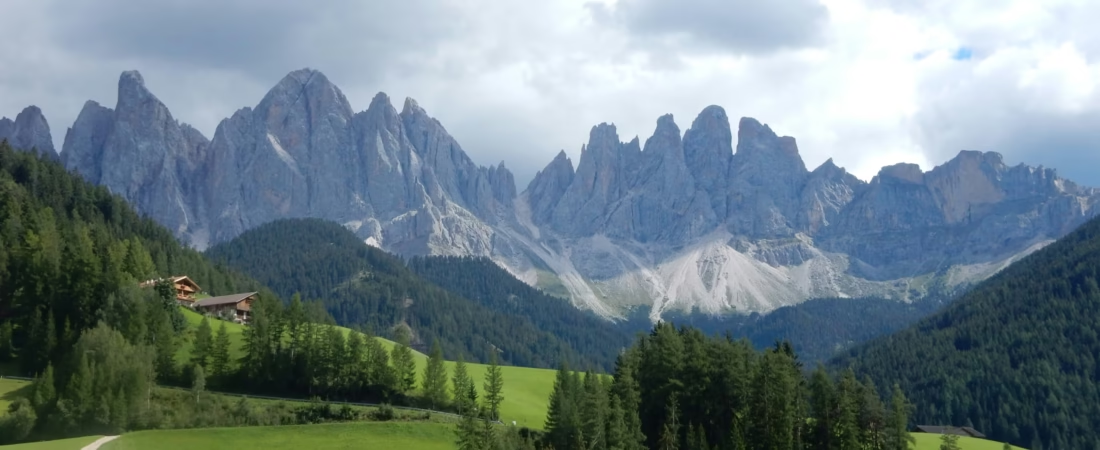
Start early. The Seceda cable car departs from Ortisei and climbs to 2,500m in under ten minutes, opening up one of the most dramatic ridge-line views in the Alps — the Odle/Geisler peaks lined up like cathedral spires. Arrive before 9:30 to beat the light and the few other visitors who make it up this early in autumn. The cable car typically operates through October before closing for maintenance in November — confirm dates at valgardena.it before you go. Return ticket: approximately €20–€26 per person.
Afternoon: Alpe di Siusi
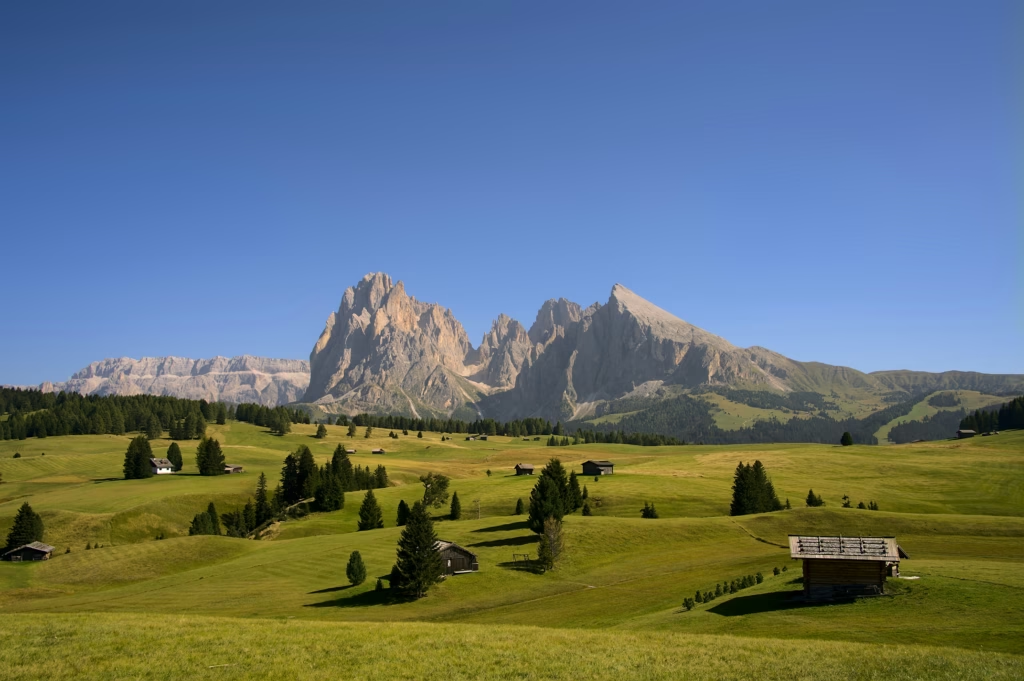
After Seceda, drive or take the gondola from Siusi/Seis up to Compatsch, the main plateau entrance of Alpe di Siusi — the largest high-altitude alpine meadow in Europe, sitting between 1,800m and 2,000m. In late October, private cars are already restricted from the plateau (this rule kicks in during summer but remains in shoulder season), which means fewer people and a quieter experience than you’d expect from such a famous landscape. The views towards Schlern/Sciliar with autumn-coloured grass and occasional fresh snow on the peaks are extraordinary.
Do the easy circular walk from Compatsch towards Saltner Schwaige, a traditional mountain hut (malga) about 40 minutes in — a perfect lunch stop for canederli (bread dumplings in broth), goulash, and local Lagrein wine. Check the hut’s closing date in advance as some malghe wrap up by end of October.
Catch the golden hour light on the plateau before heading back down. In October, sunset falls around 17:30.
What to eat in Val Gardena
- Canederli in brodo — bread dumplings in beef or vegetable broth, a staple of Tyrolean cooking
- Schlutzkrapfen — pasta half-moons filled with ricotta and spinach, locally made
- Speck — dry-cured South Tyrolean ham, nothing like generic supermarket versions
- Strudel di mele — apple strudel with raisins and cinnamon, served warm
- Lagrein — a full-bodied red wine native to South Tyrol, worth ordering by the glass
Daily budget in Val Gardena (per couple):
- Accommodation: €80–€120 (Airbnb, 1 night)
- Meals: €40–€70 per couple
- Seceda cable car: €40–€52 (two return tickets)
- Fuel & tolls (day’s driving): included in overall estimate
Day 2 — Val di Funes & Lago di Braies: The Postcard and the Lake
Morning: Val di Funes
Leave Ortisei by 8:30 and drive the 35km to Val di Funes (roughly 40 minutes via the SS242 and local roads through Chiusa). The valley is lower in altitude than the previous day, which means the access road stays open reliably throughout October — no reservations, no restrictions.
Park in Santa Maddalena village and walk 15–20 minutes uphill to the Chiesa di Santa Maddalena, the small white and red church that has become one of the most photographed spots in the Dolomites. The Odle group rises directly behind it and, in October, the mix of golden larch trees, possible dusting of snow on the peaks, and the quiet village below makes this worth every step.
Walk back down and continue a short distance to the Church of St. Johann (San Giovanni in Ranui), tucked at the base of the valley walls — a slightly different angle, equally beautiful, and almost always empty.
Afternoon: Lago di Braies
One of the best advantages of visiting in October: the Lago di Braies (Pragser Wildsee) no longer requires a pre-booked car access slot. The mandatory reservation system that operates from June to September ends in October, so you can simply drive up, park, and walk the easy loop around the lake (about 3.5km, flat, 1 hour). The turquoise water reflecting the Croda del Becco massif is already extraordinary — surrounded by autumn colours, it becomes exceptional.
Allow 45 minutes of driving from Val di Funes (via Chiusa and the Val Pusteria). Arrive before 15:00 to have good light on the water. There’s a historic hotel at the lakeside — the Hotel Pragser Wildsee — where the lakeside terrace is worth a coffee stop even if you’re not staying.
What to eat in Val di Funes & Val Pusteria
- Tris di canederli — three different dumplings (speck, spinach, cheese) on one plate
- Kaiserschmarrn — torn sweet pancake with powdered sugar and plum compote, a regional dessert
- Formaggi locali — grey cheese (Graukäse) is pungent and specific to the area; not for everyone, but worth trying
- Zelten — a dense fruit-and-nut bread typical of South Tyrol in autumn
- Weissbier or local Forst lager — the Forst brewery is based in Merano and its beers are everywhere in the region
Daily budget in Val di Funes / Val Pusteria (per couple):
- Meals: €35–€60 per couple
- Lago di Braies parking: approximately €5–€8
- No major entrance fees for either valley
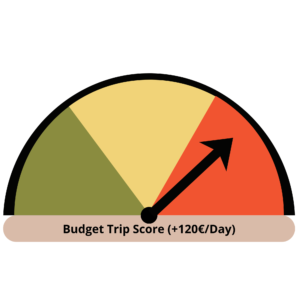
Estimated Total Budget for 2 Days — Per Couple
| Category | Estimated Cost |
|---|---|
| Accommodation (1 night, Airbnb) | €80–€120 |
| Car rental (Centauro, 2 days) | ~€105 |
| Fuel, tolls & parking | ~€200 (total trip) |
| Meals (2 days, 2 people) | €75–€130 |
| Cable cars & activities | €40–€60 |
| Total per couple | ~€500–€615 |
| Per person | ~€250–€310 + flights |
Budget tip: travelling in the last two weeks of October rather than early October often brings slightly lower Airbnb rates as the autumn leaf-peeping peak passes. Search for accommodation in Ortisei, Castelrotto, or smaller villages rather than Selva di Val Gardena, which tends to price higher.
Practical Travel Tips for the Dolomites in low Season
- Best time to visit: Late September to mid-October for larch gold, or early October for the best combination of colour and open huts. After 25 October some malghe and cable cars begin winter maintenance closures — always verify before booking.
- Getting around: A rental car is non-negotiable for this itinerary. Public buses exist but frequency drops significantly outside summer. Roads are generally clear of snow in the valleys in October, but carry chains if you plan to go above 2,000m.
- Language: South Tyrol is officially trilingual — German, Italian, and Ladin. German tends to dominate in Val Gardena and Val di Funes. A few words of German go a long way: Danke (thank you), Guten Morgen (good morning), Einen Kaffee bitte (a coffee please).
- Money-saving tip: Lunch at a malga is both cheaper and more authentic than dinner at a valley restaurant. A full lunch for two with wine rarely exceeds €35–€45 at a mountain hut, versus €55–€80 at an evening restaurant in a tourist village.
- Layers are essential: Temperatures at altitude can drop to 0–3°C in the morning even when the valley sits at 12°C. Bring a proper waterproof layer and trail shoes with ankle support — the trails are not technical, but can be muddy and slippery after rain.
Link to Map for free.
For more similar trips, click on one of the images.